Sustainable Food Cooling Without CO₂ Emissions
Preventing Food Loss
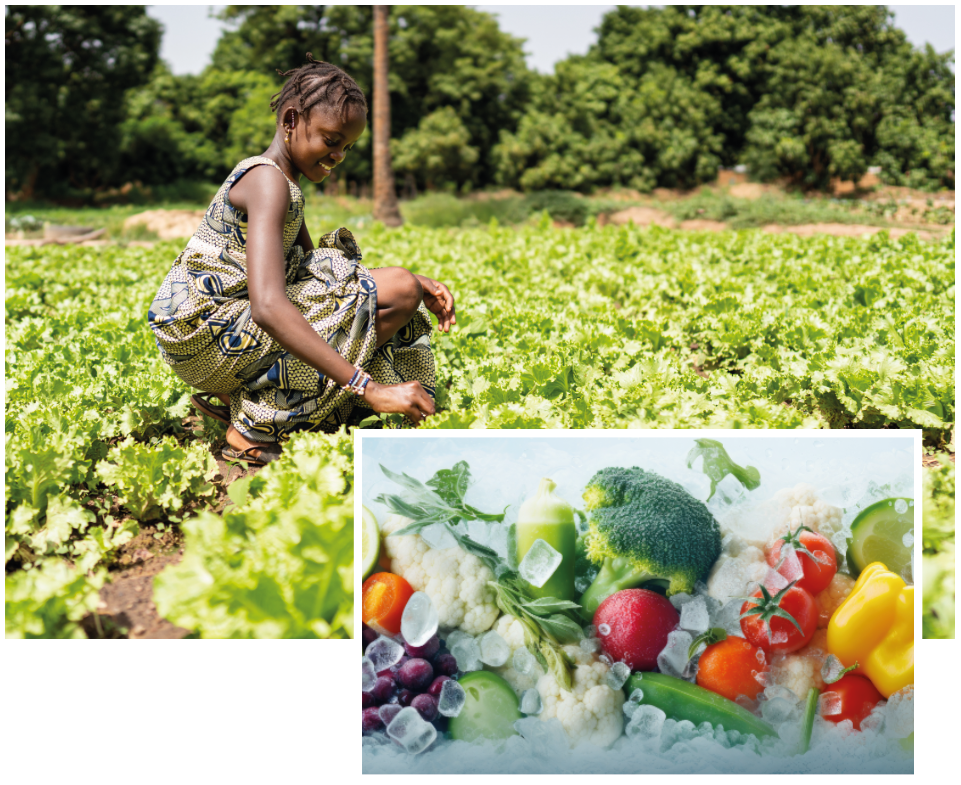
„Saving food is just as important as producing it. 80 % of the 828 million people affected by hunger in 2021 lived in rural areas. At the same time, 70 % of the food produced in Africa comes from smallholder farmers who own 1–2 acres of land but are among the world’s poor, living on less than $2 a day. Interestingly, the food that is lost and wasted each year could feed 1.26 billion people suffering from hunger. In 2017, approximately 12 % of the food produced worldwide was lost due to a lack of efficient cold chains, with 63 % of that amount occurring in low-income countries. Food losses caused by the lack of cold chains were also estimated at 1 gigatonne of CO₂-equivalent emissions, which accounts for one-third of the total emissions from the global carbon footprint of food loss and waste.“
Mary Najjuma (Ph.D. candidate at London South Bank University)
The Concept of the Perfect Cold Chain
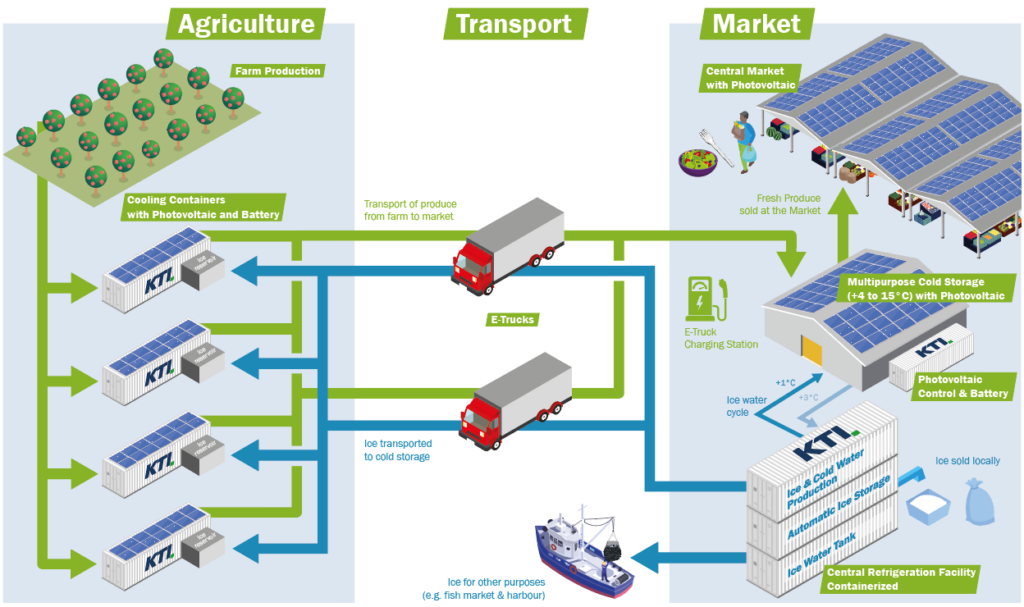
Refrigerated container
Agricultural products are harvested and can be cooled and stored directly in the field in off-grid refrigerated containers equipped with ice storage tanks and photovoltaic systems.E-Trucks (Electric Trucks)
The ice is loaded onto refrigerated electric trucks, which transport it to the farm, where it is used to pre-cool the produce.E-Trucks (Electric Trucks)
The pre-chilled agricultural products are transported by refrigerated electric trucks from the off-grid refrigerated containers to the multipurpose cold storage facility at the market.Central cooling system using natural refrigerants
The KTI refrigeration system is the heart of the cooling concept. It produces and stores ice and ice water. The ice water cools the multipurpose cold storage facility, while ice can be produced at the same time. The ratio of ice to ice water depends on the cold storage facility’s cooling requirements.Iron Pickup and Delivery
The sheet ice produced is stored in a refrigerated ice storage facility equipped with an automatic ice distribution system, which enables the loading and unloading of ice to various locations and for different purposes.
The ice can be sold to local customers (fisheries, bakeries, butcher shops, breweries, and various private and industrial buyers).
Multipurpose Cold Storage Facility
The multipurpose cold storage facility consists of several cold storage rooms with different, individually adjustable temperatures and humidity levels. At the multipurpose cold storage facility at the market, products can be further chilled and stored for a longer period of time or sold directly. Unsold products can be returned from the market to the multipurpose cold storage facility to be sold on another day.
PV Control Container with Batteries
The entire photovoltaic system is controlled from a separate container located near the multipurpose cold storage facility. From there, electricity is supplied to the entire central refrigeration system. Electric trucks can also be charged there.
Photovoltaic modules
The photovoltaic modules will be installed on the roof of the multipurpose cold storage facility and on the roofs of the nearby supermarket, or at suitable locations in the surrounding area.
Your Benefits
- Coverage of the entire cold chain
- Food savings of approximately 70,000 metric tons per year
- 100 % Renewable Energy
- Photovoltaics
- No CO₂ emissions
- Natural refrigerants
- Global Warming Potential – GWP = 0
- Ozone Depletion Potential – ODP = 0
- Maximum energy efficiency—50 % lower power consumption
- Durability, Longevity
- Customer Service
- State-of-the-art refrigeration technology for extreme climatic conditions
